


Drunk Driving Deaths Per Year in Colorado Springs
How Many Drunk Driving Deaths Per Year in Colorado Springs
Drunk driving is a serious public safety concern that many communities across Colorado face every year, including in Colorado Springs and throughout El Paso County. Every year, fatal accidents involving alcohol- or drug-impaired drivers result in deaths, serious injuries, and criminal charges that all could have been prevented. Recent statistics from the Colorado Department of Transportation (CDOT) show that impaired driving continues to contribute to a big portion of traffic fatalities statewide, with El Paso County seeing the highest number of impaired driving deaths in Colorado in recent years.
Understanding how many drunk driving deaths per year in Colorado Springs requires looking at both local and statewide crash data. Although Colorado Springs-specific fatality totals are not consistently reported separately through CDOT or other local law enforcement agencies, El Paso County statistics, where Colorado Springs is located, provide insight into the dangers facing drivers throughout the area and how frequently driving impaired can turn into a fatal accident.
At the Law Office of Steven Rodemer, our team of DUI defense lawyers in Colorado Springs represents individuals who are facing DUI, DWAI, and other criminal charges in Colorado Springs. Our criminal defense firm helps clients understand what Colorado’s impaired driving laws are, the consequences of an impaired driving conviction, and the legal defenses that may be available based on the circumstances of their cases.
Colorado Springs Drunk Driving Death Data
According to the 2025 Colorado fatal crash dashboard from the Colorado Department of Transportation, El Paso County recorded 29 fatalities in crashes involving an impaired driver during that year out of the 241 fatal suspected impaired driving accidents that year throughout the state. The CDOT Impaired Driving safety page states that there were 236 fatalities related to impaired driving in 2025. This discrepancy in fatalities is typically due to the dashboard always being updated over time, versus an article that was written and has not been updated.
Regardless, this is the highest county fatality total in Colorado that year. Because Colorado Springs is located within El Paso County, these statistics provide insight into the region’s impaired driving problem, and just how many people lose their lives to preventable accidents every year.
However, the 29 fatalities represent the entire county, and not just Colorado Springs alone. The available figures do not establish how many of these deaths occurred only within Colorado Springs city limits.
A February 11, 2026, report from KKTV also identified El Paso County as having the highest number of impaired driving deaths statewide in 2025.
The five Colorado counties with the highest numbers of fatalities involving impaired drivers were:
- El Paso County – 29 fatalities
- Weld County – 25 fatalities
- Denver County – 23 fatalities
- Adams County – 21 fatalities
- Jefferson County – 20 fatalities
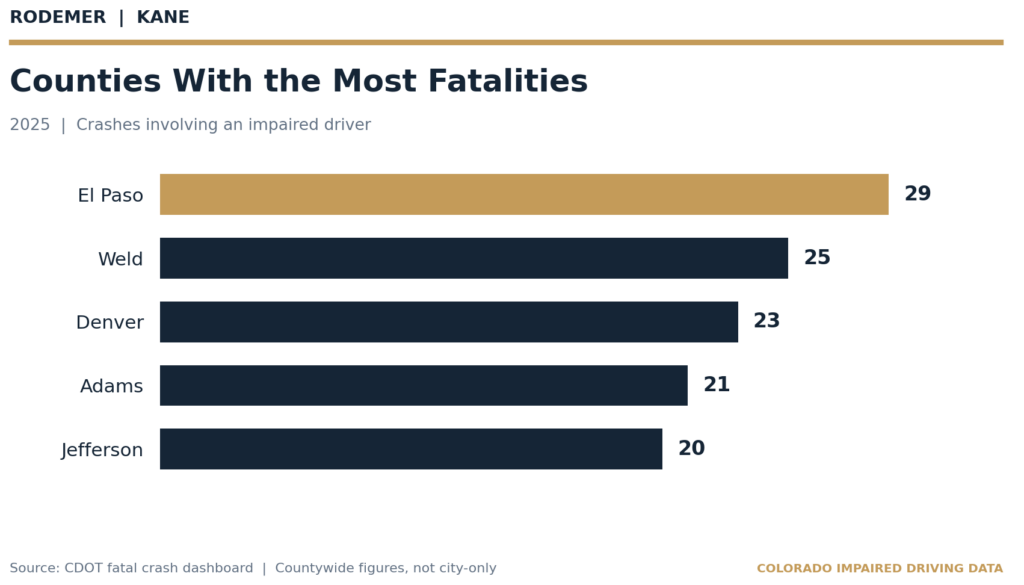
Together, these five counties accounted for 118 fatalities out of the 241 total fatal car accidents in 2025 involving impaired drivers who were under the influence of drugs, THC, alcohol, or a mixture of all three. El Paso County alone represented approximately 12.3% of the 241 statewide fatalities reported for 2025.
These stats include crashes involving alcohol, drugs, or other impairing substances. They should not be interpreted as alcohol-only drunk driving fatalities or as the number of drivers who were intoxicated when they died.
Colorado Drunk Driving Deaths by Year
Statewide drunk driving fatality statistics provide additional context for those who are trying to understand the frequency of impaired driving deaths in Colorado Springs and surrounding communities.
According to CDOT’s Fatal Crash Data Dashboard, the following numbers represent those who lost their lives in crashes involving impaired drivers between 2021 and 2025:
- 2021: 255 fatalities
- 2022: 286 fatalities
- 2023: 227 fatalities
- 2024: 215 fatalities
- 2025: 236 fatalities
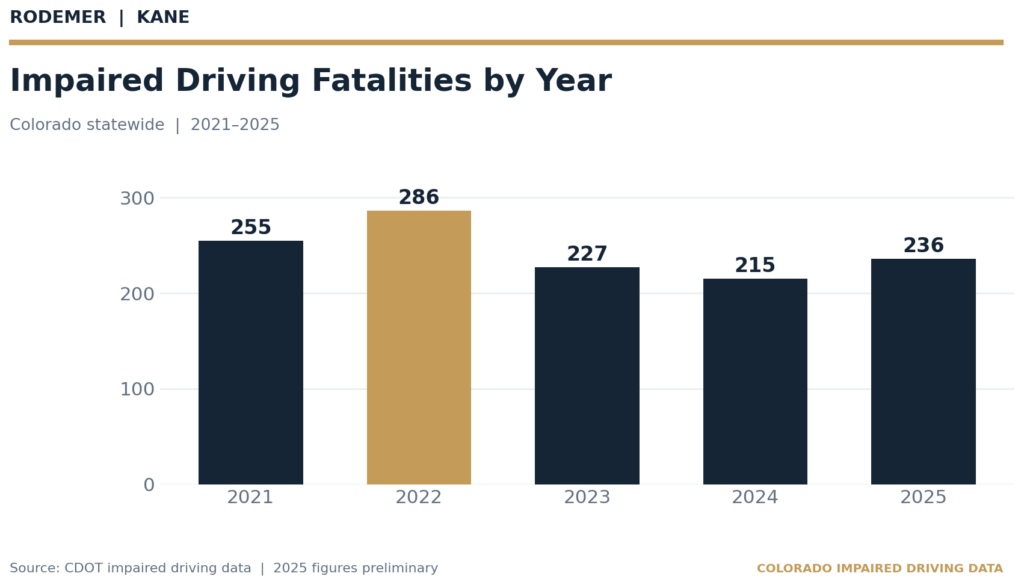
Colorado recorded a combined 1,219 fatalities in crashes involving impaired drivers over this five-year period. The year that saw the highest impaired driving fatalities was 2022, when 286 people lost their lives. Fatalities subsequently declined in the following years, 2023 and 2024, before increasing again in 2025.
The increase from 215 deaths in 2024 to 236 in 2025 is approximately a 9.8% increase. Although the 2025 total remained below the 2022 peak, the increase in DUI fatalities shows that impaired driving continues to be a significant roadway safety problem, not just in Colorado Springs, but throughout the entire state.
CDOT identified its 2025 fatal crash statistics as preliminary, based on data that had been reported as of January 7, 2026. These numbers may change over time as crash investigations are completed and official records are updated by the respective law enforcement agencies across the state.
Percentage of Colorado Traffic Fatalities Involving Impaired Drivers
The number of impaired driving fatalities is only one way to measure the problem of driving while impaired on public roadways. Looking at the total percentage of all traffic deaths involving an impaired driver compared to the total traffic fatality deaths helps show how frequently impairment contributes to fatal accidents in the state.
CDOT has provided statistics for 2015 through 2025, which show the following percentages:
- 2015: 33%
- 2016: 32%
- 2017: 37%
- 2018: 35%
- 2019: 29%
- 2020: 34%
- 2021: 37%
- 2022: 37%
- 2023: 32%
- 2024: 31%
- 2025: 34%
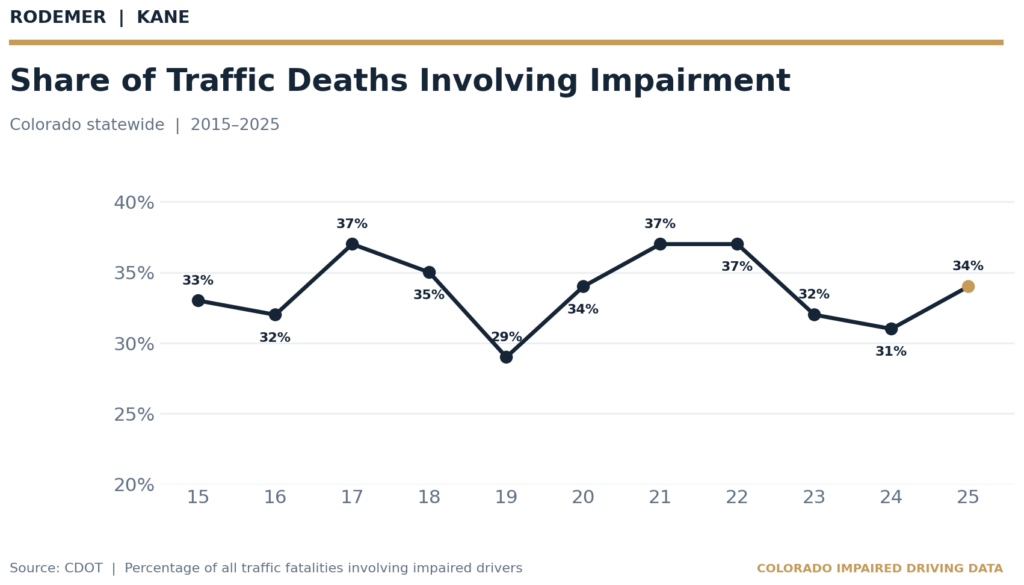
Over this 11-year period, the percentage of total traffic deaths involving impaired driving ranged from 29% to 37%. The highest percentages occurred in 2017, 2021, and 2022, while 2019 recorded the lowest percentage of impaired driving fatalities. In 2025, 34% of Colorado traffic fatalities involved an impaired driver, which is higher than the 31% in 2024.
Essentially, the data tells us that approximately one in three traffic fatalities statewide involved driver impairment, whether it is from drugs, alcohol, THC, or a combination of them. However, the figures do not necessarily establish that impaired driving was the sole cause of every fatal accident.
These statistics also show why impaired driving enforcement programs remain a priority for law enforcement agencies throughout Colorado, including those that serve Colorado Springs and El Paso County.
Colorado DUI and DWAI Laws
Colorado has established specific laws that address driving under the influence of alcohol, marijuana, prescription medications, and other impairing substances. These laws also address the penalties for being convicted of driving under the influence of drugs, alcohol, or both.
Under Colorado Revised Statutes § 42-4-1301, drivers may face different charges depending on their level of impairment and the evidence that is collected by law enforcement during an investigation.
- Driving Under the Influence (DUI) – A driver may be charged with DUI when they are found to have alcohol, drugs, or a combination of substances in their system that substantially affects their ability to operate a vehicle safely on public roadways. Colorado also establishes a DUI per se offense for when a driver’s blood or breath alcohol concentration is found to be 0.08% or higher within the statutory testing period of 2 hours.
- Driving While Ability Impaired (DWAI) – DWAI applies when alcohol or drugs affect a person’s ability to drive a vehicle safely to even the slightest degree. Having a blood alcohol concentration above 0.05% but below 0.08% creates a permissible inference of impairment while operating a vehicle, although other evidence may also be considered.
- Drug-Impaired Driving – Colorado prohibits anyone from driving while impaired by marijuana, prescription medications, or illegal drugs of any kind. A whole-blood concentration of at least five nanograms of active Delta-9 THC per milliliter creates a permissible inference that the driver was under the influence of cannabis and therefore was a danger to others on the road around them.
- Underage Drinking and Driving – Colorado has stricter alcohol-related driving restrictions for drivers who are younger than 21. Under certain circumstances, a driver under 21 with a blood alcohol concentration between 0.02% and 0.05% may face an underage drinking and driving charge.
A driver does not necessarily need to exceed the 0.08% alcohol threshold to face criminal charges for driving under the influence. Prosecutors may pursue an impairment-based charge when other evidence, such as roadside tests, supports the allegations.
Vehicular Homicide Charges Involving Impaired Driving
When a motor vehicle accident involving an impaired driver results in someone’s death, prosecutors in Colorado may pursue charges that are considerably more serious than an ordinary DUI.
Under C.R.S. § 18-3-106, Colorado outlines the definition of vehicular homicide offenses involving reckless driving and driving under the influence, and the resulting penalties for being convicted.
- A person may face a class 3 felony vehicular homicide charge when prosecutors use evidence to establish that the person who operated a motor vehicle did so while under the influence of alcohol or drugs and that the conduct resulted in another person’s death.
- A conviction for DUI-related vehicular homicide can result in various penalties, including:
- A substantial prison sentence
- Mandatory parole
- Fines
- Other collateral consequences
The applicable sentencing range for homicides resulting from driving under the influence depends on Colorado’s felony sentencing laws and the specific circumstances of the offense.
Contact the Law Office of Steven Rodemer for DUI Defense in Colorado Springs
The number of impaired driving deaths per year in Colorado Springs and El Paso County reflects the serious consequences that come with choosing to drive while under the influence. With 29 fatalities reported across El Paso County in 2025, local DUI death statistics show why law enforcement agencies continue to devote substantial resources to DUI enforcement throughout the region.
However, an arrest for a DUI or DUI-related homicide is not the same as a conviction. Individuals who are accused of impaired driving retain important constitutional rights that they should exercise, and prosecutors have the burden of establishing the required elements of a criminal offense.
Our team at The Law Office of Steven Rodemer represents individuals who are facing DUI, DWAI, and other criminal charges in Colorado Springs. Our firm works diligently to protect our clients’ rights, evaluate the evidence against them, and pursue appropriate legal defenses based on their individual circumstances.
Don’t hesitate to contact the Law Office of Steven Rodemer today to schedule a consultation with a Colorado Springs criminal DUI defense attorney from our team. We will review the circumstances of your arrest, explain the charges you face, and discuss your available legal options.